


This is Life as a Sacred Text 🌱, an everybody-celebrating, justice-centered voyage into ancient stories that can illuminate our own lives. It‘s run on a nonprofit, so it’s 100% NAZI FREE. More about the project here, and to subscribe, go here:
Painful family legacies, when they heal, do not heal quickly.
Abraham, after his own childhood trauma, did not find it in him to fight for either of his sons. Isaac’s silence did not harm his children to the same extent that Abraham’s did, but his passivity enabled one to trick another, for preference to be taken, unjustly.
And Jacob, who helped himself to that unfair preferential treatment for himself, gives it, freely, to one of his children—at the expense of the others’.
Why he does so makes sense—perhaps, unconsciously, as we’ll see in a moment.
Interestingly, the child that is chosen—picked out, beloved, held up, is the one that is, in both Biblical and later Jewish readings, the kid with the most interesting things going on in terms of gender, gender presentation and sexuality. (Of course, these are all different things, but they’re somewhat conflated in the texts that we’ll see today.) Let’s explore, shall we?
It begins even before Joseph is born; first, the Rabbis of the Talmud notice a strange phrasing in Genesis 30:21 and extrapolate that Dina’s sex must have changed in utero, and come up with the following midrash:
“Rav Joseph challenged [the previous statement, never mind what they were talking about, by raising this case]: “And afterwards she bore a daughter and called her name Dinah” (Gen. 30:21). What is meant by ‘afterwards’? Rav said: After Leah had passed judgment [dana din—a wordplay on Dina’s name] on herself, saying, ‘Twelve tribes are destined to issue from Jacob. Six have issued from me [already] and four from the enslaved-women [Bilhah and Zilpah], making ten. If this child will be a male, my sister Rachel will not be equal to one of the enslaved-women [in bearing sons]. Immediately the child was turned to a girl, as it says, ‘And she called her name Dinah!’” (Talmud Brachot 60a)
Another midrashic source, the Targum Pseudo-Jonathan, (Genesis 30:21) extends this midrash to suggest that Rachel was actually already pregnant at the same time, and, at this moment of Leah’s prayer, Joseph and Dina were switched in their mothers’ uteri:
Before God, Leah’s prayer was heard, and the fetuses were switched in their wombs; Joseph was placed in Rachel’s womb and Dinah in the womb of Leah.
This midrash then gets cited in Jewish legal responsa, like the late 19th/early 20 c. Responsa Tzur Yaakov from Rabbi Avraham Yaakov HaLevi Horowitz of Probizhna, Ukraine, which explains (ch. 28):
Certainly, this means that Joseph’s body in Leah’s womb was transformed into a female, while Dinah’s body in Rachel’s womb was transformed into a male, and their souls were transferred from each womb to the other.
So according to this reading, both Dina and Joseph transitioned gender even before they were born! (For the Rabbis, this helped to explain why Dina might engage in such non-gender appropriate activities like “leaving the house,” as discussed last week).
And as for Joseph? Well, it’s implied that there’s a connection between this reading and some of what’s discussed below. But again, gender and gender presentation and sexuality are all different things—though intertwined, for some people. I will try to tease them out, the best that I can.
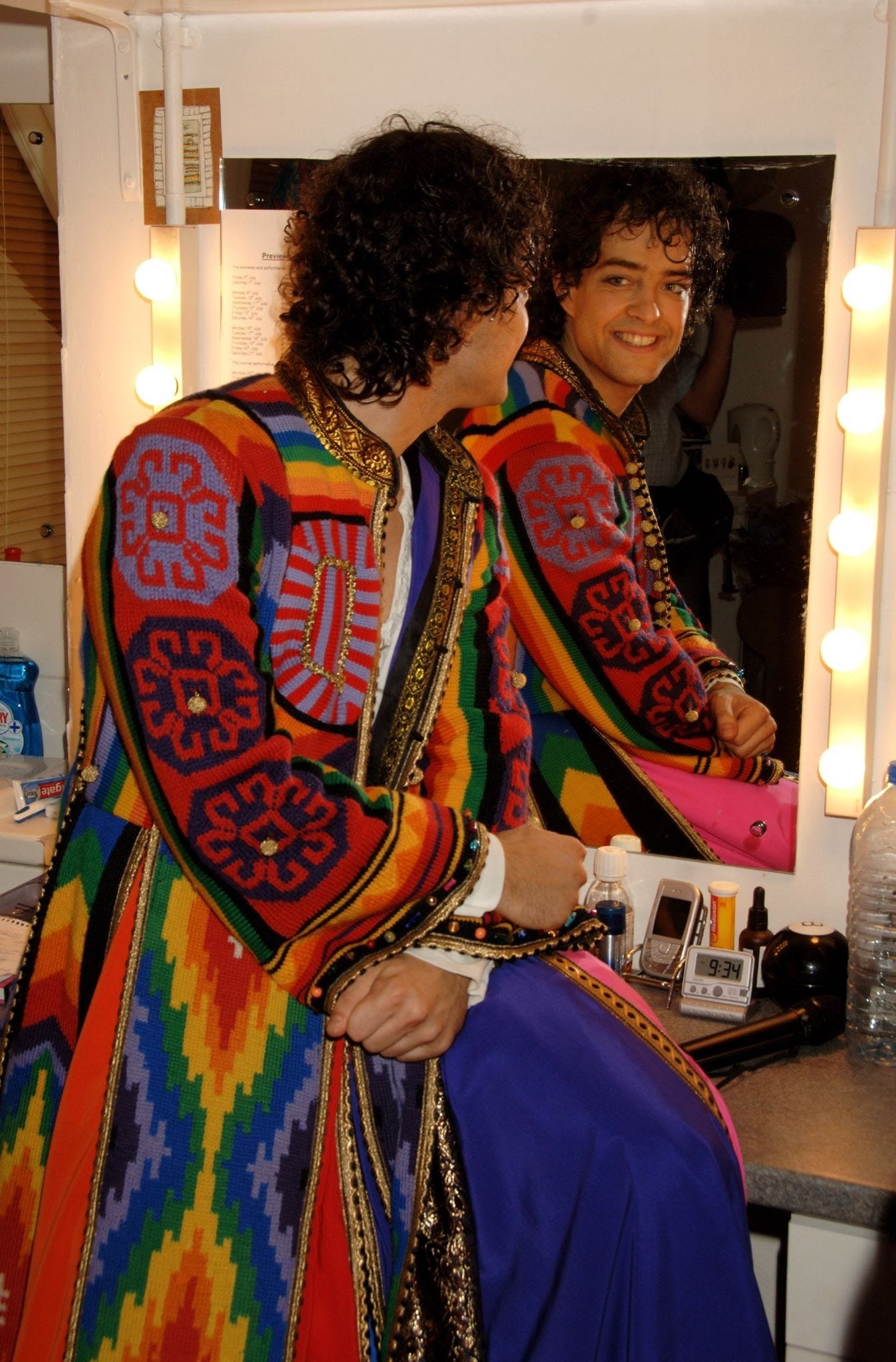
This, then, is the line of Jacob: At seventeen years of age, Joseph tended the flocks with his brothers, and was like a youth to his father’s wives Bilhah and Zilpah…. Now Israel loved Joseph best of all his sons, for he was the child of his old age; and he had made him a striped tunic. (Genesis 37:2-3)
First of all, midrash is surprised that Joseph is described as being like a youth, despite already being all of seventeen years old already. (Remember, adulthood happened in the ancient world at puberty, so seventeen really was late for them.) So what gives?
The Rabbis of midrash—Genesis Rabbah (which likely dates no later than the early fifth century CE, in what’s now the land of Israel, which was then occupied by the Romans), explained it thusly:
He was seventeen years old, yet you say, was like a youth! It means, however, that he behaved like a boy—pencilling his eyes, lifting his heels, and curling his hair. (Genesis Rabbah 84:7)
My friend Robbie Medwed, who is a gifted Jewish educator and former professional queer Jew, comments, using a spelling of Joseph’s name that more accurately reflects the Hebrew:
“The rabbis of the midrash throw “youthful” like a pejorative and come for Yosef’s high-maintenance grooming habits, saying he “touched up his eyes, he picked up his heels, he fixed his hair,” but instead of succeeding in dragging Yosef and leading us to believe his femininity was shameful.…the rabbis seem to be jealous of Yosef’s ability to use his gender presentation as a fabulous display of power and ambition.
And what of this striped tunic? It’s a very specific phrase, k’tonet passim, one we see in only one other place in the Bible, describing King David’s daughter Tamar.
“She was wearing a striped tunic, for maiden princesses were customarily dressed in such garments. (II Samuel 13:18)”
So yeah, Jacob gave Joseph a stripey princess tunic, or perhaps a princess dress, which it seems he wore, happily. (I’m going with the pronouns offered by the Torah, and am reading Joseph, with the help of these texts, as a gender nonconforming person who uses he/him pronouns. That’s certainly not the only option available, here, but in the absence of any evidence, textual or otherwise, that Joseph would have used other pronouns, I’m going to make do with what we have. I also think that as a cis person looking at this text, my hermeneutic choices should be somewhat more conservative than those available to trans and nonbinary readers, who may be able to take more liberties engaging Joseph’s gender in these texts.)

What about Joseph’s appearance? This is one of those “translation can be fascinating” kind of moments. Even if you don’t know Hebrew, have a look at the words that are bolded. I’m just going to leave the JPS translation for your entertainment-slash-other feelings.
Sign up for FREE or MORE to keep reading. ❤️ 🌱